
Leadership That Builds Capability Beyond the Leader
Alauddin Ahmed · Aug 2026
Leadership is often described through personal strengths: urgency, decisiveness, resilience, communication, ambition, and the ability to get things done. These qualities matter, but organizations experience leadership through something more tangible: the quality of decisions, the way pressure is handled, the confidence of the team, and whether work continues when the leader is not in the room.
This edition explores three dimensions of effective leadership: balancing performance with judgment, building capability beyond the individual leader, and creating the conditions for change to be adopted and sustained.
At ValueInfinity, we see these as connected challenges. Leadership becomes more durable when individual behaviour is reinforced by clear expectations, defined decision rights, strong operating rhythms, practical coaching, and change routines that support learning and adaptation.
The common thread
Leadership is measured not only by individual performance, but by the quality of decisions, ownership, and learning that continue across the team.
Balance the Strengths Organizations Already Value
Organizations often reward the most visible side of leadership: acting quickly, solving problems, communicating confidently, and driving for results. This does not argue against these strengths — it asks leaders to pair them with complementary behaviour so that short-term performance also builds trust, resilience, and long-term capability.
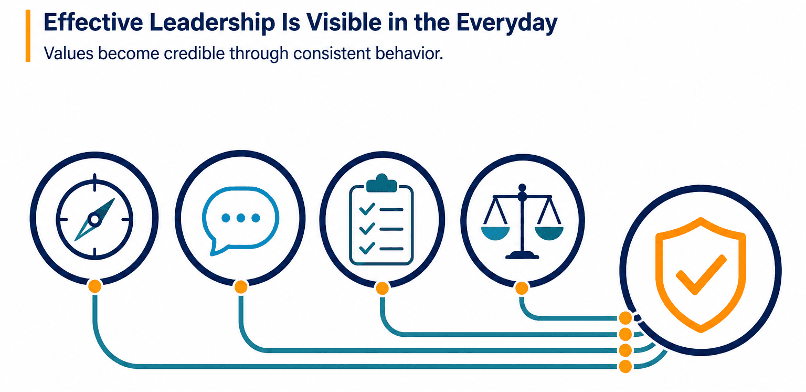
1. Pace with judgment — A strong bias for action is valuable, especially when time and momentum matter. But speed is more effective when leaders know when to pause, reflect, and consider the broader consequences of a decision, including dependencies, trade-offs, and potential unintended impacts. The goal is not to slow decision-making; it is to distinguish between decisions that benefit from speed and those that require more deliberate judgment.
2. Performance with humanity — Firefighting under pressure demonstrates resilience, but repeated firefighting should also prompt leaders to ask what needs to change so the same issue does not return. Getting things done remains essential, but performance is more sustainable when accountability is balanced with empathy, collaboration, and an understanding of operational constraints.
3. Direction with participation — Ambition and drive create energy, but empowering others allows that energy to spread through the team. Articulate communication gives people direction, while active listening brings more voices and operational insight into the solution. Confident use of authority is sometimes necessary; sharing the mic builds the ownership and engagement required for the direction to hold.
These balances become visible in ordinary operating moments: a portfolio review where pressure for speed is high, a cross-functional handover where ownership is unclear, a missed milestone that requires both accountability and learning, or a team discussion where the leader must decide whether to direct, coach, challenge, or listen. Clear roles and decision rights reduce unnecessary intervention. A well-designed management cadence separates routine review from exception escalation and strategic decisions, while PDCA reviews turn setbacks into learning.
Leadership review question
Which behaviours does our culture consistently reward, and which important behaviours may be getting overlooked as a result?
Build Capability Beyond the Leader
When the leader steps away, hidden dependencies often become visible: decisions that were never fully delegated, meetings that rely too heavily on one person's context, stakeholders who are unclear on where to turn, and capable team members who have not yet had enough opportunity to exercise judgment.
A planned absence can therefore create space for the team to step up, communicate differently, and test its own decision-making capacity. The value is not in the leader simply being unavailable, but in creating the conditions for others to take greater ownership and operate with confidence.
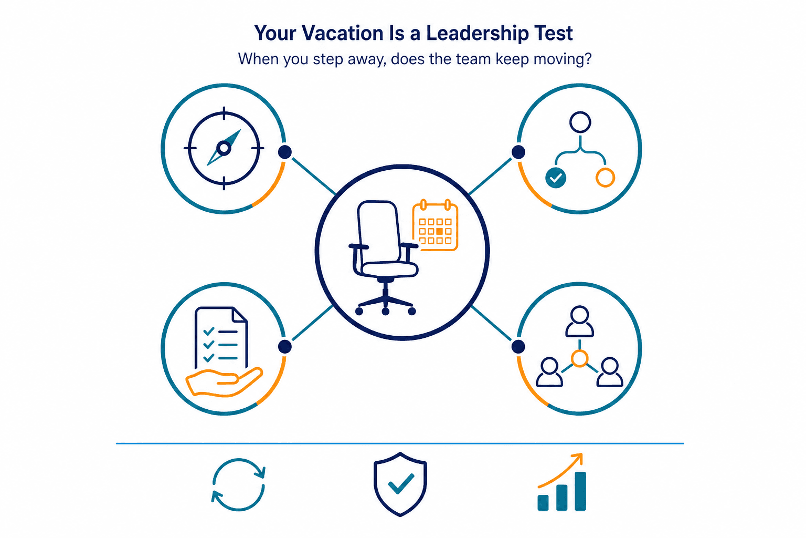
1. Gain perspective and create room — Stepping away gives the leader a fresh perspective on what truly belongs on the calendar and what can be handled elsewhere. Delegation then gives the team space to build confidence — more than assigning temporary coverage, the team needs clarity about priorities, authority, risks, and the decisions it can make without seeking permission.
2. Build support around the team — Involve peers and cross-functional stakeholders so the team has access to support while the leader is away. Prepare potential successors, offer lower-risk stretch projects, and consider upward delegation by creating connections between the team and the leader's manager.
3. Return with a better operating model — The final step is reflection. What continued smoothly? Where did people hesitate? Which stakeholder relationships helped? What work did not need to return to the leader's calendar? The answers should improve the operating model rather than simply restore the previous pattern.
A useful test
If the team can cover tasks but cannot make decisions, delegation has occurred — but authority has not moved.
Lead Change Through Adoption
A new process, structure, system, or technology can be designed and launched without becoming the way the organization actually works. Change leadership closes that gap — it connects strategic intent to the daily choices, skills, incentives, resources, and routines that determine whether people can adopt the future state.
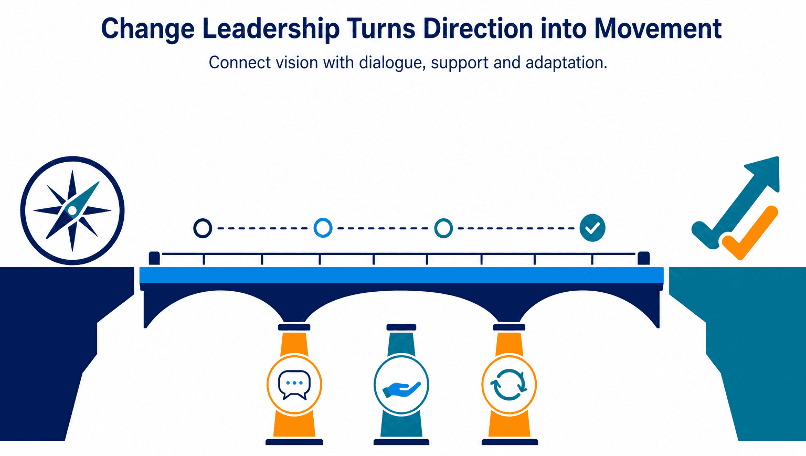
1. Establish direction and align the culture — Leaders first need to articulate why the change matters, what outcomes it should create, and how the work of different teams connects to those outcomes. That direction must be reinforced by the culture: openness, resilience, learning, and collaboration need to be demonstrated in the way the change is led, not only described in the launch message.
2. Communicate, engage, and support — Transparent communication should explain the reasons for change, the process, the practical implications, and the expected results. Engagement creates room for concerns and operational insight to shape implementation, while empowerment provides the skills, resources, authority, coaching, and practical support people need as roles and expectations evolve.
3. Adapt without losing the purpose — Change rarely unfolds exactly as planned. Leaders need the agility to respond to evidence and feedback while keeping the intended outcomes clear. Adaptability is not a retreat from the direction; it is how the organization improves the route while protecting the purpose.
ValueInfinity's change-readiness work tests five ingredients before launch: vision, incentives, skills, resources, and an action plan. If one is missing, the risk usually becomes visible in predictable ways — confusion, resistance, anxiety, frustration, or false starts. From there, adoption follows an operating sequence: diagnose the current state, mobilize clear ownership, embed the future state in workflows and day-to-day expectations, and use a PDCA cadence to review evidence and adapt.
Adoption signal
If the initiative has technically launched but decisions, workarounds, and daily behaviours remain unchanged, implementation is not complete.
Building Leadership Capacity
Taken together, the three perspectives form one connected system of leadership and execution. Balanced behaviour builds credibility: urgency is strengthened by reflection, accountability by humanity, and authority by participation. Clear priorities, decision rights, guardrails, and stakeholder support build capacity — allowing judgment and ownership to develop beyond one individual. And direction, cultural alignment, engagement, enablement, and PDCA-based review create movement — helping people translate intent into sustained ways of working.
The practical measure of leadership is therefore larger than the performance of the individual leader. It is the capability that remains in the organization: to make sound decisions, coordinate across functions, respond to risk, learn from evidence, and keep moving when conditions change.
How ValueInfinity Can Help
ValueInfinity helps organizations strengthen leadership and execution through practical management systems — not leadership language in isolation. Operating-model and capability work clarifies roles, decision rights, cross-functional interfaces, central-team structures, and capability roadmaps. Change-readiness and sustainment work assesses the conditions for adoption, shapes phased implementation plans, and embeds new workflows, controls, measures, and review routines. And leadership and operational excellence development blends structured reflection, practical problem solving, PDCA, Lean Six Sigma, applied learning, and follow-up coaching to strengthen capability and reinforce new behaviour over time.
Whether the immediate challenge is an over-dependent team, unclear decision ownership, a transformation that is struggling to gain traction, or a leadership group that needs a stronger operating rhythm, the work begins by making the current system visible and then building the routines and capabilities that allow progress to continue. If these perspectives resonate, we would be glad to explore how they apply to your organization.